Loading

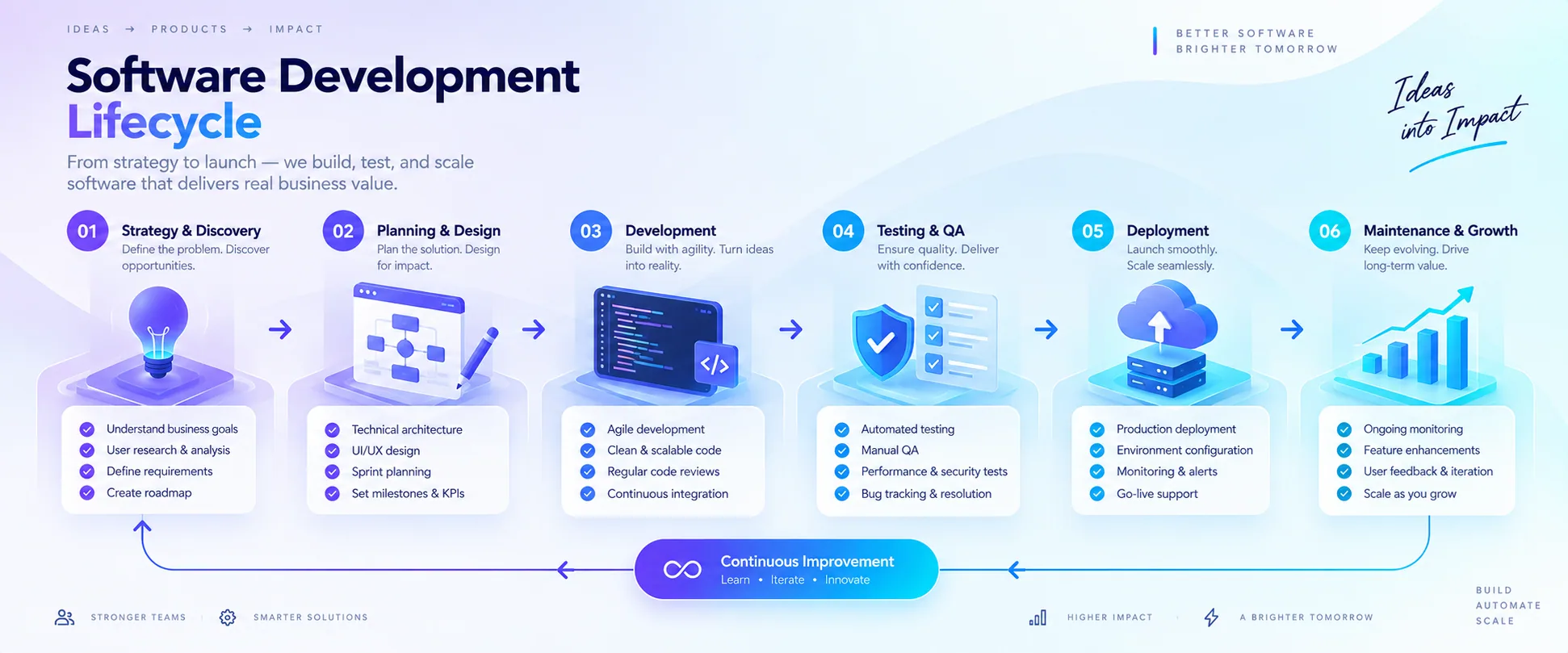
Most automation projects fail by building before the process is understood. This is the sequence we follow instead.
Discovery and mapping come before any technology decision. That ordering is the whole approach.
Understand the existing process, the tools already in use, and where the real bottleneck sits.
You receive
A written description of the current process and the specific bottleneck.
Your involvement
A conversation with whoever actually runs the process day to day.
Map the conversations, data, business rules and actions that make up the workflow today.
You receive
A step-by-step map of conversations, data, rules and actions as they exist today.
Your involvement
Reviewing the map with your team to catch the exceptions nobody documented.
Decide what should be automated, what should be integrated, and what needs to be custom-built.
You receive
A scoped plan naming what gets automated, integrated or custom-built - and what stays manual.
Your involvement
Confirming integration feasibility against your actual systems, not assumed ones.
Develop the AI agents, automation logic or software the architecture calls for.
You receive
Working software or a configured agent, developed against the agreed scope.
Your involvement
Regular checkpoints so scope drift surfaces early rather than at handover.
Connect the solution to the CRM, calendars, databases and channels you already run.
You receive
Live connections to your CRM, calendars, databases and channels.
Your involvement
Credential setup with you, scoped to least privilege.
Test the workflow end to end, including edge cases, failure paths and access permissions.
You receive
Verified behaviour on the happy path, the edge cases and the failure paths.
Your involvement
You testing it against real scenarios before anything goes live.
Deploy with monitoring and a rollback path, and hand over documentation.
You receive
A deployed system with monitoring, a rollback path and handover documentation.
Your involvement
An agreed go-live window and a named point of contact.
Monitor real usage, measure against the original bottleneck, and refine.
You receive
Measurement against the baseline we captured in discovery.
Your involvement
Reviewing real usage and refining what the data shows is not working.
It is a working conversation about your process, not a pitch deck.
Not every process should be automated. These are the tests we apply before recommending anything.
When automation is the right call
These shape every engagement and they are the reason we argue for narrower first phases than most.
Describe the process that is slowing you down. You will get a clear view of what is worth automating, and an honest answer if the answer is nothing.